

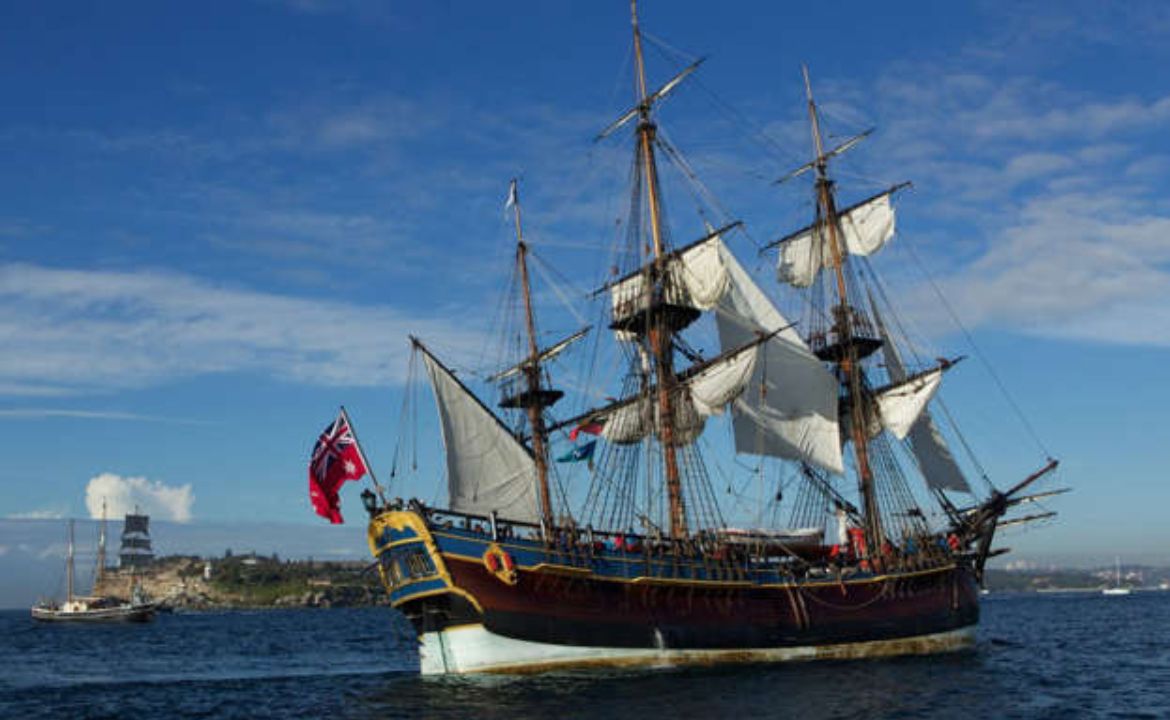
In the annals of maritime exploration, few vessels have left as indelible a mark on world history as HMS Endeavour. This modest British Royal Navy research vessel, originally built as a coal carrier, would embark on a voyage that fundamentally altered humanity’s understanding of the Pacific Ocean, contributed invaluable scientific knowledge, and reshaped the geopolitical landscape of the 18th century. The story of this remarkable ship is one of transformation, discovery, and enduring legacy.
From Humble Beginnings to Historic Vessel
HMS Endeavour began its life far from the spotlight of exploration. Constructed in 1764 in Whitby, England, the vessel was initially named the Earl of Pembroke and served as a collier—a coal transport ship. Built from sturdy oak with a broad, flat-bottomed hull designed for shallow waters and heavy cargo, the ship exemplified the practical workhorses of British maritime commerce. It measured approximately 106 feet in length and 29 feet in beam, with a burden of 368 tons.
In 1768, the British Admiralty purchased the vessel and refitted it for a scientific expedition. Renamed HMS Endeavour, the ship underwent extensive modifications to accommodate a crew of nearly 100 men, scientific equipment, and provisions for an extended voyage. The selection of this particular vessel was no accident; its shallow draft would prove invaluable for navigating uncharted coastal waters, while its spacious hold could store the supplies necessary for a multi-year journey.
Captain Cook’s First Voyage
The transformation of HMS Endeavour from merchant vessel to exploration ship coincided with one of the most significant scientific expeditions of the Age of Enlightenment. In August 1768, under the command of Lieutenant James Cook (not yet a captain), the ship departed Plymouth, England, with a dual mission. The official objective was to observe the transit of Venus across the sun from Tahiti—an astronomical event crucial for calculating the distance between Earth and the sun. The secret orders, sealed until after the Venus observation, directed Cook to search for the fabled Terra Australis, the great southern continent that geographers believed must exist to balance the landmasses of the northern hemisphere.
The expedition carried not just sailors but also scientists, artists, and gentlemen scholars. Among them was Joseph Banks, a wealthy botanist whose personal entourage and extensive collection of specimens would transform the voyage into one of the most productive scientific expeditions in history. The ship became a floating laboratory, equipped with astronomical instruments, botanical presses, and equipment for preserving specimens.
Discoveries That Reshaped the World
The voyage of HMS Endeavour lasted nearly three years, from 1768 to 1771, covering approximately 30,000 miles. After successfully observing the transit of Venus in Tahiti, Cook opened his sealed orders and sailed south, then west, becoming the first European to chart the eastern coastline of Australia. The expedition mapped New Zealand’s entire coastline, proving it consisted of two main islands rather than being part of a larger continent.
The scientific achievements were staggering. Banks and his colleague Daniel Solander collected over 30,000 plant specimens, including more than 1,400 species previously unknown to Western science. The expedition’s artists, including Sydney Parkinson, created detailed illustrations of plants, animals, and indigenous peoples, providing Europe with its first accurate depictions of the Pacific world. These contributions laid the foundation for modern botany, ethnography, and Pacific studies.
The cultural encounters during the voyage were complex and consequential. While Cook attempted to minimize violence and establish peaceful relations with indigenous peoples, the expedition inevitably marked the beginning of European colonization’s devastating impact on Pacific societies. The landing at Botany Bay on April 29, 1770, would eventually lead to British settlement of Australia, forever changing the continent’s trajectory and the lives of its Aboriginal inhabitants.
Navigational Brilliance and Near Disaster
The skill required to navigate HMS Endeavour through uncharted waters cannot be overstated. Cook’s meticulous cartography produced maps of such accuracy that they remained in use for decades. However, the journey was fraught with danger. In June 1770, the ship struck the Great Barrier Reef off the coast of Queensland, tearing a hole in the hull. Through remarkable seamanship and desperate measures—including throwing cannons and ballast overboard—the crew managed to beach the ship and conduct repairs. They spent seven weeks on the Australian coast, an unplanned stay that allowed for extensive botanical collection and interactions with Aboriginal peoples.
The near-disaster on the reef highlighted both the dangers of exploration and the robust construction of the Whitby-built collier. The ship’s sturdy hull and flat bottom, originally designed for navigating the shallow waters around British coal ports, proved ideal for both withstanding the reef’s impact and facilitating beach repairs.
Legacy and Final Years
After returning to England in July 1771, HMS Endeavour completed its mission, but its adventures were not over. The ship served in the Royal Navy for several more years before being sold into private service. Renamed Lord Sandwich, it ended its days as a transport ship during the American Revolutionary War. In 1778, the vessel was deliberately scuttled in Newport Harbor, Rhode Island, as part of a blockade against French forces.
For centuries, the exact location of the wreck remained a mystery, becoming one of maritime archaeology’s holy grails. In recent years, researchers have identified a site in Newport Harbor believed to contain the remains of the historic vessel, though conclusive identification remains elusive and contested.
Enduring Impact
The voyage of HMS Endeavour represents a pivotal moment in human history when scientific inquiry, maritime skill, and imperial ambition converged. The ship’s journey expanded European geographical knowledge, contributed enormously to natural sciences, and initiated profound changes in the Pacific world—changes whose effects continue to resonate today.
Modern replicas of HMS Endeavour, including the HM Bark Endeavour Replica in Australia, allow new generations to appreciate the vessel’s design and the extraordinary challenges faced by 18th-century explorers. These replicas serve as floating museums, reminding us that world-changing exploration was conducted aboard a modest ship originally designed to carry coal along England’s coast.
The story of HMS Endeavour transcends maritime history. It embodies human curiosity, the drive to explore unknown horizons, and the complex consequences of cross-cultural encounters. As we reflect on this vessel’s journey, we recognize both the remarkable achievements of its crew and the lasting impact—both positive and devastating—that their discoveries brought to the indigenous peoples of the Pacific. In understanding this duality, we gain deeper insight into how a single ship truly changed the course of history.















Leave a Reply